Chander Agarwal and the Infrastructure Behind India's Next Logistics Transformation

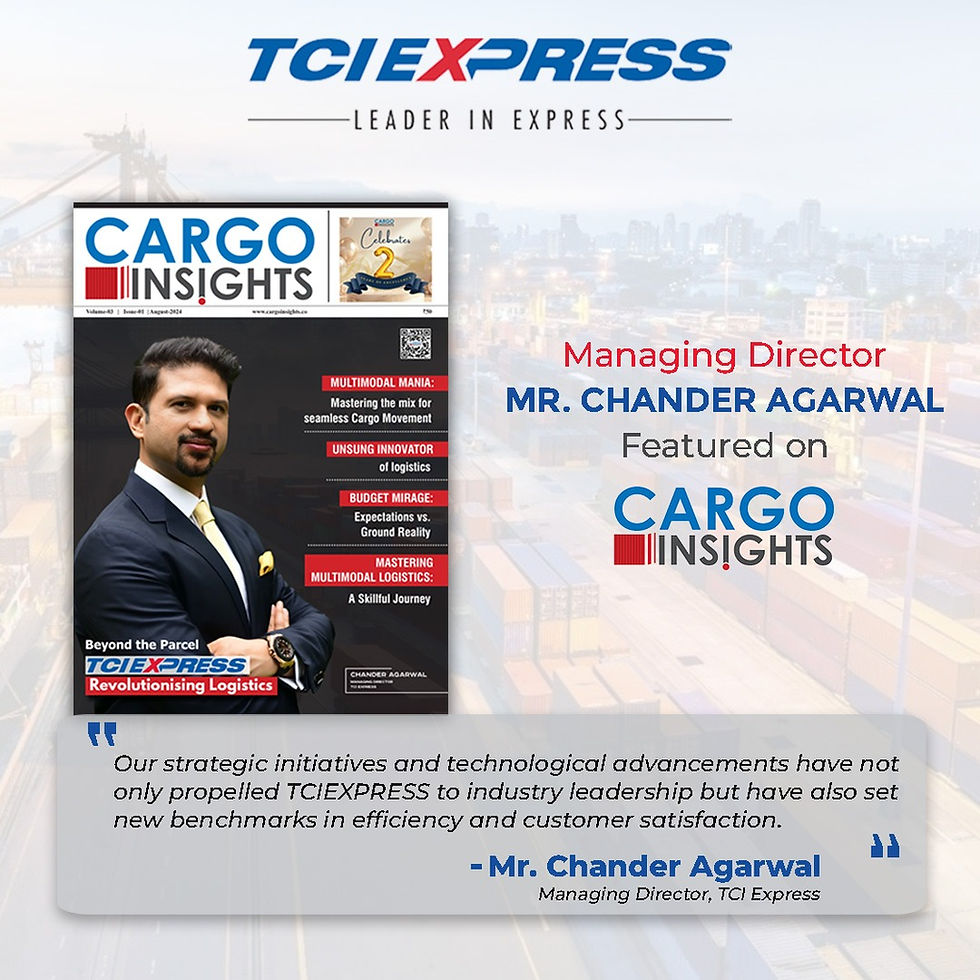
India's logistics transformation is often described through familiar terms such as faster deliveries, digital tracking, e-commerce and automated warehouses. Yet underneath all of these developments lies a more fundamental requirement: infrastructure.
Roads, airports, rail networks, sorting centres, distribution facilities, branches, technology systems and urban planning collectively determine how efficiently goods can move through an economy.
For Chander Agarwal, Managing Director of TCI Express, this connection between infrastructure and logistics has become increasingly important. His role involves strategic development and financial direction at TCI Express, while his professional experience spans express logistics, international business and the development of a wider distribution network.
The importance of this infrastructure-led perspective was particularly visible in TCI Express's recent participation in discussions around India-Singapore trade and infrastructure. During the FICCI CEO Delegation to Singapore, Chander Agarwal engaged with infrastructure and policy stakeholders on subjects connected with urban planning, freight movement and resilient supply chains.
This suggests a broader understanding of logistics.
Express delivery does not exist independently of the infrastructure around it.
A highly efficient logistics company can optimise routes and processes, but the quality of roads, airports, rail connections, urban freight corridors and distribution hubs ultimately influences what is possible.
That makes infrastructure not merely a supporting function of logistics, but one of its most important strategic foundations.
Chander Agarwal and the Infrastructure Perspective
The traditional logistics conversation often begins with transportation.
How many vehicles are available?
How quickly can a shipment be delivered?
How many branches does the company operate?
How many locations can it reach?
These remain important questions.
But a more sophisticated logistics perspective asks another question:
What infrastructure allows all of these capabilities to work together?
A delivery vehicle needs an efficient route.
A sorting centre needs reliable transportation connections.
An airport gateway needs road access.
A branch needs to be connected to the wider network.
A digital tracking system needs an operational network capable of acting on the information it provides.
This is why infrastructure and logistics efficiency are inseparable.
TCI Express provides information about its infrastructure through its official Infrastructure page, while its Express Services portfolio illustrates how different transportation capabilities operate within the broader network.
The Hidden Infrastructure Behind Express Delivery
When customers receive a shipment, they usually see only the final stage.
A parcel arrives at a destination.
But the actual journey may involve multiple stages.
It may begin with pickup from a business location, move to a branch, travel to a sorting centre, pass through a transportation hub, connect with an air or surface route, reach a destination facility and finally move through last-mile delivery.
Every stage depends on infrastructure.
This means a logistics network can be viewed as a chain of connected infrastructure points.
If one link becomes inefficient, the impact can spread across the entire journey.
A bottleneck at a sorting centre can delay outbound transportation.
Urban congestion can affect last-mile delivery.
Limited airport capacity can influence time-sensitive air cargo.
Weak connections between transport modes can increase handling and transit time.
Infrastructure planning therefore has a direct relationship with delivery performance.
Chander Agarwal and the Importance of Urban Infrastructure
One of the most interesting dimensions of Chander Agarwal's recent industry engagement is the connection between urban planning and logistics.
The TCI Express analysis of the FICCI CEO Delegation to Singapore highlights how urban infrastructure influences last-mile efficiency, predictable transit schedules and operational costs.
This is particularly relevant to India.
As cities grow, freight movement increasingly competes with passenger transportation.
A delivery vehicle may need to enter dense commercial areas, navigate congestion and complete multiple deliveries within a limited time.
The challenge is not simply to put more vehicles on the road.
It is to create urban environments where freight can move efficiently.
That can involve:
better freight corridors;
strategically located logistics hubs;
appropriate zoning;
efficient road connections;
improved traffic management;
multimodal transportation links; and
greater coordination between urban development and freight requirements.
For express logistics, these factors directly influence service reliability.
What Singapore Can Teach India's Logistics Industry
Singapore provides an interesting reference point because its urban and infrastructure planning has long incorporated freight movement into wider economic development.
The TCI Express discussion of the Singapore infrastructure ecosystem highlights the relationship between industrial zones, ports, airports, transport corridors and logistics hubs.
The lesson for India is not that Indian cities should simply copy Singapore.
The contexts are very different.
India has a much larger geographical area, a vastly larger population and highly diverse urban environments.
The more useful lesson is that freight should be considered when cities and economic zones are planned.
If industrial areas, commercial districts, airports, highways and logistics centres are designed independently, transportation inefficiencies can emerge.
If they are considered as parts of one economic system, logistics performance can improve.
Infrastructure and the Growth of Indian Businesses
Infrastructure matters because logistics is ultimately an enabler of commerce.
A manufacturer needs components.
A retailer needs inventory.
An e-commerce company needs fulfilment and delivery.
An exporter needs access to international markets.
A pharmaceutical business needs dependable movement of time-sensitive products.
An SME needs access to customers outside its home city.
All of these activities depend on logistics.
This means logistics infrastructure can influence how quickly businesses can scale.
A company with access to dependable distribution can expand its customer base without building its own transportation network.
This is particularly important for India's growing SME ecosystem.
Chander Agarwal and the SME Opportunity
Recent TCI Express discussions around its FY27 roadmap highlight growing demand from small and medium enterprises. The company's Q1 FY27 strategic update links infrastructure expansion with broader customer reach and growth across several express logistics segments.
For SMEs, logistics infrastructure can act as a force multiplier.
A small manufacturer does not necessarily need its own national distribution network.
Instead, it can use a logistics provider with established branches, transportation routes, sorting facilities and delivery capabilities.
This changes the economics of expansion.
A business in one city can potentially reach customers across India without establishing warehouses and transportation operations in every market.
Logistics therefore becomes an infrastructure service that enables entrepreneurship.
The Relationship Between Network Density and Service Quality
A dense logistics network can provide several advantages.
It can reduce the distance between customers and operational facilities.
It can increase the number of possible transportation connections.
It can support more frequent movement.
It can improve pickup and delivery flexibility.
It can also create better opportunities to optimise transportation.
But network density alone is not enough.
The network must be managed effectively.
Branches need to be connected.
Sorting centres need adequate capacity.
Transportation schedules need coordination.
Information must flow between locations.
This is where leadership and technology become important.
Chander Agarwal's role is therefore not simply about expanding the physical footprint.
It involves considering how the different components of the network work together.
Automated Sorting and Infrastructure Productivity
Sorting infrastructure is one of the most important components of an express logistics network.
A sorting centre receives shipments from different origins and directs them towards appropriate destinations.
The efficiency of this process influences the rest of the network.
If sorting is slow, downstream transportation can be delayed.
If sorting is inaccurate, shipments can enter the wrong route.
If capacity is insufficient, congestion can develop during peak periods.
Automation can address some of these challenges.
TCI Express has been investing in automated sorting infrastructure as part of its network development. Its FY27 roadmap includes planned mega automated sorting centres in Mumbai, Ahmedabad, Kolkata and Chennai.
These locations are strategically significant because they represent major commercial and transportation markets.
The broader principle is straightforward:
Better infrastructure can create better logistics capacity.
Chander Agarwal and the Next Generation of Sorting Infrastructure
Automated sorting is not simply about machines.
It requires an ecosystem.
The facility needs adequate space.
Transportation connections must be reliable.
Technology systems need to integrate with operations.
Employees need to understand the new processes.
Maintenance and contingency capabilities must be available.
The facility must also be positioned where it can efficiently connect multiple parts of the network.
This is why infrastructure investment requires strategic thinking.
A sorting centre cannot be evaluated only by its physical capacity.
Its real value comes from how effectively it connects with the rest of the network.
Air Connectivity and Time-Definite Logistics
Air transport plays an important role in time-sensitive logistics.
Businesses may require urgent movement of documents, components, electronics, medical products or other time-critical consignments.
TCI Express provides Domestic Air Express and International Air Express services as part of its broader express logistics portfolio.
The effectiveness of air logistics depends on more than aircraft availability.
It also depends on:
airport access;
cargo handling;
road connectivity;
sorting capacity;
documentation;
shipment acceptance;
destination processing; and
final-mile delivery.
This is another example of why logistics infrastructure should be considered as an integrated system.
An efficient airport cannot compensate for inefficient connections before and after the flight.
Rail as Part of a Multimodal Network
Rail can also play an important role in India's logistics ecosystem.
TCI Express offers Rail Express as part of its express logistics services.
The strategic value of rail lies partly in its ability to provide an additional transportation option for suitable shipments and routes.
A resilient logistics network benefits from having more than one transportation pathway.
Surface transportation remains essential.
Air transportation provides speed.
Rail can provide another option for specific requirements.
The objective is not to make every shipment multimodal.
The objective is to select the most appropriate combination of transportation modes for each requirement.
Infrastructure and International Trade
The relationship between logistics infrastructure and international trade becomes even more important as India strengthens its position in global supply chains.
Exporters need reliable access to airports and ports.
Importers need predictable inland movement.
International businesses need documentation and customs processes to function smoothly.
Logistics providers need the ability to coordinate domestic and international stages.
Chander Agarwal's participation in the India-Singapore Business Forum reflects this broader relationship between logistics and international commerce. TCI Express reported that the forum addressed cross-border logistics, resilient supply chains and efficient trade corridors.
For Indian businesses, stronger trade corridors can create opportunities to reach new customers and suppliers.
For logistics providers, they create the need for stronger international capabilities.
Singapore and the Idea of Connected Trade Corridors
The India-Singapore relationship provides a useful example.
Singapore functions as a major commercial and logistics hub within Southeast Asia.
For Indian companies, connectivity with Singapore can support access to wider regional business networks.
But connectivity requires more than bilateral trade agreements.
Businesses need practical logistics routes.
They need documentation.
They need customs coordination.
They need dependable transportation.
They need shipment visibility.
They need delivery arrangements at the destination.
This is why Chander Agarwal's focus on cross-border logistics is relevant to the broader business environment.
Trade becomes easier when logistics becomes easier to plan.
The Role of Digital Infrastructure
Physical infrastructure is only one part of the equation.
Modern logistics also depends on digital infrastructure.
A shipment may physically move through branches, sorting centres, airports and roads, but customers experience the process through information.
They want to know:
Has the shipment been picked up?
Where is it?
Has it reached a sorting facility?
Is it in transit?
Has it reached the destination?
When will delivery occur?
TCI Express provides shipment tracking, allowing customers to access information about their consignments.
For logistics management, digital information has an additional function.
It can help identify operational exceptions and support decision-making.
This means physical and digital infrastructure increasingly operate as one system.
Chander Agarwal and the Digital-Physical Connection
The most effective logistics networks of the future are unlikely to be purely physical or purely digital.
They will combine both.
A sorting centre without digital coordination can become inefficient.
A tracking system without physical operational capacity cannot solve delivery problems.
A route optimisation platform needs real-world transportation resources.
A customer portal needs accurate operational data.
The value is created when these components interact.
This is one reason logistics leadership increasingly requires an understanding of both technology and physical infrastructure.
Infrastructure and E-Commerce
E-commerce has made the relationship between infrastructure and customer experience particularly visible.
An online order creates an expectation.
The customer expects the product to move from seller to destination efficiently.
This requires fulfilment infrastructure, sorting, transportation, delivery capacity and information systems.
TCI Express provides dedicated E-Commerce Express capabilities to support this market.
The growth of e-commerce therefore places additional pressure on logistics infrastructure.
It also creates opportunities for innovation.
Networks need to handle changing volumes.
Sorting systems need to process parcels efficiently.
Delivery systems need to support different customer requirements.
Reverse logistics needs to be considered.
The infrastructure must therefore be flexible as well as large.
The Importance of the Last Mile
The final stage of logistics is often the most visible to the customer.
It is also one of the most complex.
Urban congestion, building access, delivery windows, customer availability and address accuracy can all affect performance.
The last mile is therefore strongly influenced by urban infrastructure.
Better road planning can help.
Well-designed commercial zones can help.
Digital address systems can help.
Efficient delivery routing can help.
Strategically located distribution points can help.
This is another reason why logistics companies need to engage with the wider infrastructure ecosystem rather than focusing exclusively on their own operations.
Chander Agarwal and Infrastructure-Led Growth
A major logistics company can expand in two ways.
It can focus primarily on increasing volumes through existing infrastructure.
Or it can invest in infrastructure that creates additional future capacity.
The second approach requires more capital and longer-term planning.
But it can create a stronger foundation for sustainable growth.
TCI Express's recent FY27 roadmap illustrates this infrastructure-led approach, with plans for automated sorting centres and expansion beyond 1,000 direct company-owned branches.
Chander Agarwal's responsibility for strategic development and financial direction makes the balance between infrastructure investment and commercial returns particularly relevant.
Infrastructure should not be built simply because it is possible.
It needs to support identifiable customer demand and long-term network requirements.
Financial Discipline Behind Infrastructure
Infrastructure is capital-intensive.
A sorting centre requires investment.
Technology requires investment.
Vehicles require investment.
Branches require investment.
Expansion therefore needs financial planning.
This is why Chander Agarwal's financial responsibilities are important when examining his leadership approach.
The company's financial reports and investor information provide stakeholders with access to corporate and financial disclosures.
For a listed logistics company, infrastructure strategy must ultimately be connected with financial sustainability.
The goal is not simply to build more.
It is to build the right capabilities in the right places at the right time.
Infrastructure, Sustainability and ESG
Infrastructure also has an environmental dimension.
Large logistics facilities consume energy.
Transportation networks consume fuel.
Construction requires materials.
Urban freight movement affects congestion and emissions.
Therefore, future infrastructure needs to be evaluated through both commercial and sustainability perspectives.
TCI Express maintains a dedicated Environmental, Social and Governance section covering its ESG approach.
The company's awards page also lists recognitions connected with sustainability, including sustainable organisation awards and LEED-related infrastructure recognition.
Sustainable infrastructure can therefore become part of long-term logistics competitiveness.
Infrastructure and Resilience
A resilient logistics network needs infrastructure that can handle changing conditions.
This can mean sufficient sorting capacity.
It can mean alternative transportation routes.
It can mean multimodal options.
It can mean geographically distributed facilities.
It can mean digital visibility.
It can also mean contingency planning.
TCI Express's logistics resilience analysis emphasises process discipline, planning, visibility and multimodal choices as important tools for managing logistics during changing market conditions.
Infrastructure therefore becomes part of resilience.
The stronger and more flexible the network, the more options management has when circumstances change.
The Human Infrastructure of Logistics
There is another form of infrastructure that receives less attention: people.
A sorting centre requires skilled employees.
Branches require operational teams.
Vehicles require drivers.
Technology systems require specialists.
Customer service requires trained professionals.
Management requires people capable of interpreting information and making decisions.
TCI Express's official corporate platform highlights its professional workforce as an important component of its operating model.
This means infrastructure investment needs to be accompanied by investment in people.
A highly automated facility still needs employees who understand how the system works.
A sophisticated tracking platform still needs customer service teams capable of responding to exceptions.
Technology can increase capability, but people convert capability into service.
Building Infrastructure for India's Next Economic Phase
India's economic expansion is likely to create new logistics requirements.
Manufacturing growth can increase movement of components and finished goods.
E-commerce can increase parcel volumes.
SME expansion can increase demand for nationwide distribution.
International trade can increase cross-border shipments.
Healthcare and pharmaceutical sectors can create specialised logistics requirements.
Retail expansion can increase replenishment needs.
Each trend creates pressure on infrastructure.
This means logistics infrastructure will increasingly become part of India's economic infrastructure.
Chander Agarwal's Broader Leadership Context
Chander Agarwal's leadership can therefore be viewed beyond the traditional boundaries of an express logistics company.
His role connects several areas:
Logistics operations through the movement of goods.
Infrastructure through the development of physical network capability.
Technology through digital visibility and operational systems.
Finance through capital allocation and financial direction.
International business through cross-border connectivity.
Governance through board and committee responsibilities.
Sustainability through ESG considerations.
Industry engagement through participation in wider business discussions.
This combination reflects how the role of a modern logistics leader is changing.
Recognition and Industry Standing
Chander Agarwal's leadership has also received industry recognition.
The official TCI Express Awards and Recognitions page currently lists the ET Young Industry Leader – 2025 (Mr. Chander Agarwal). It also records recognitions across sustainability, workplace culture, logistics and business performance.
These awards are useful indicators of external recognition, but the more significant question is how leadership translates into organisational capability.
In infrastructure-intensive industries, leadership is ultimately reflected in the systems a company builds.
The Future of Logistics Infrastructure in India
The next generation of Indian logistics infrastructure is likely to become more connected, automated and data-driven.
Sorting centres will increasingly incorporate automation.
Transportation networks will use more digital information.
Urban logistics will require greater coordination.
Air, rail and road infrastructure will need stronger connections.
International trade corridors will become increasingly important.
Sustainability will influence facility design and operations.
And customers will expect greater visibility throughout the process.
These developments will require logistics companies to think beyond individual facilities.
The future belongs to connected networks.
Conclusion
Chander Agarwal's leadership at TCI Express provides an interesting lens through which to understand the changing relationship between logistics and infrastructure in India.
Express logistics is not simply about vehicles.
It is not simply about warehouses.
It is not simply about technology.
It is the interaction between all of these systems.
A shipment can move quickly only when roads, sorting centres, transportation modes, digital systems, people and processes work together.
This is why infrastructure has become one of the defining strategic issues for Indian logistics.
Recent TCI Express discussions around Singapore's infrastructure ecosystem, India-Singapore trade, logistics resilience and future growth investment illustrate how closely infrastructure, trade and logistics are becoming connected.
For Chander Agarwal, the leadership challenge is therefore larger than building a bigger logistics network.
It is about building a network that is more connected, adaptable, visible and capable of supporting India's changing economy.
As Indian businesses expand across regions and international markets, the quality of logistics infrastructure will increasingly influence their ability to compete.
The logistics network of the future will need to be faster, but also smarter.
It will need to be larger, but also more flexible.
It will need to use more technology, while continuing to depend on people.
And it will need to support growth while remaining financially and environmentally responsible.
That is the infrastructure challenge facing Indian logistics.
It is also one of the most important areas in which the leadership of Chander Agarwal and the evolution of TCI Express can be understood.
Frequently Asked Questions
Who is Chander Agarwal?
Chander Agarwal is the Managing Director and Executive Director of TCI Express. The company's official corporate information states that he is responsible for strategic development and financial direction.
Why is infrastructure important for logistics?
Infrastructure determines how efficiently goods can move through a network. Roads, sorting centres, branches, airports, rail connections and digital systems all contribute to delivery performance.
What infrastructure does TCI Express use?
TCI Express operates a network supported by branches, sorting centres, transportation assets, air gateways, technology systems and delivery locations. Its Infrastructure page provides further information.
How does urban planning affect logistics?
Urban planning influences freight movement, congestion, delivery times, route efficiency and access to commercial areas. Better coordination between urban development and freight infrastructure can improve logistics efficiency.
What did Chander Agarwal discuss during the FICCI CEO Delegation to Singapore?
The TCI Express report on the FICCI CEO Delegation discusses infrastructure planning, urban logistics, freight corridors and the importance of integrated infrastructure for efficient supply chains.
How does infrastructure support e-commerce?
E-commerce depends on fulfilment facilities, sorting capacity, transportation routes, delivery networks and digital visibility. TCI Express provides dedicated E-Commerce Express services.
Does TCI Express offer multiple transportation modes?
Yes. Its service portfolio includes Surface Express, Domestic Air Express, International Air Express and Rail Express.
How does infrastructure support logistics resilience?
Infrastructure creates capacity and alternatives. Sorting centres, transportation routes, multimodal services and geographically distributed facilities can give logistics companies more options when operating conditions change.
Has Chander Agarwal received leadership recognition?
Yes. The official TCI Express Awards and Recognitions page lists ET Young Industry Leader – 2025 (Mr. Chander Agarwal) among its recognitions.


Comments